


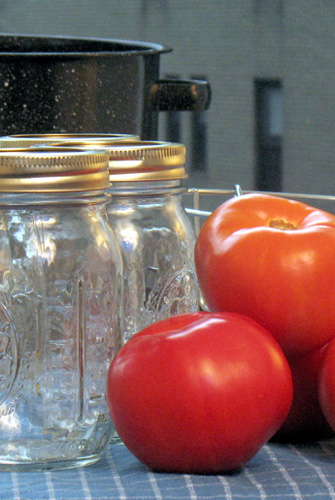
Hardware & Software: Canning and Preserving
Preserving fresh foods when they are in season, plentiful, cheap and at their best flavor is the only way we can eat these foods year-round. Whether it's for politics, nutrition or budget, canning is another way to have more control over what we eat.
For many of us of a certain age or because we grew up in a city or suburb, canning can seem like a quaint notion. My childhood was suburban and at a time when baby boom conveniences, combined with post-war agribusiness (think TV dinners and Tang) and feminism kept many parents, i.e., mothers, out of the kitchen. My mother was an excellent cook who had grown up on a farm, yet I never saw her show the slightest interest in canning. Thinking back, my images of canning were entirely formed from watching 4-H competitions in movies like "State Fair" or visiting a girlfriend's grandmother who'd make jars of peach jam every summer.
It is notable that to find a better way to eat -- healthier, with more flavor and with better eco-politics -- we are increasingly looking in the rear view mirror. We seek the wisdom of earlier generations to relearn practices that if not lost, at least have been neglected for a while. And canning is on that list.
As I've mentioned to friends that I was interested in learning how to can, every single reaction mentioned strawberry preserves. But what I had in mind was tuna fish. My obsession with learning to can began with a photograph I saw in Eugenia Bone's book, Well-Preserved. Recipes and Techniques For Putting Up Small Batches of Seasonal Foods ($24.95, Clarkson Potter, paperback with color photographs).
In the photo a well-worn antique silver three-pronged fork is lifting a thick flake of oily canned tuna out of a jar. In soft focus behind it is another opened glass jar, filled with pink chunks of the preserved tuna. I knew that if I could create that tuna, I would never buy another can of Progresso again. And then there's the dream of opening a pint jar of tangy and red New Jersey tomatoes on a raw February Sunday afternoon, spilling them into my cast iron Le Creuset pot along with the ingredients for a winter beef stew. I had to do this.
Still, canning seems intimidating if only for one word: botulism. It seems dumb to try to make that winter stew if it becomes our last meal.
Which brings me back to Eugenia Bone. If you want to learn how to preserve your food, you need a teacher and a coach. Eugenia Bone is a New Yorker who lives in an apartment with a notably unfancy, small kitchen. Her book will teach you six methods of food preservation: water bath canning (what we would recognize if we made strawberry jam or canned tomatoes), pickling, pressure canning, freezing, preserving in oil, and curing and smoking.
We sat down with Eugenia in her New York City apartment to help us put canning comfortably into the hands of other city cooks with small kitchens. See our link to the left of the screen to our podcast conversation with her.
Ms. Bone is meticulous in her instructions and explaining the food science and food safety of each preservation method. She's talked with the food scientists and the people at the USDA and she will teach you the rules. Hers is not one of those cookbooks you skim and then jump ahead to the recipes. Instead it's important to sit and read the front of the book, maybe with a pen in your hand to make notes or underline. This is also not cooking with substitutions and improvisation. This is science and you need to do it correctly, leaving the improv to what you do with the food "after" it's been preserved.
Evident throughout the book, including the nearly appealing 90 recipes that follow the methodology, is Ms. Bone's exceptionally well-tuned palate and her astute understanding about how food connects us. "Preserving is not about immediate satisfaction (for that, eat the cherries fresh). It's about anticipation. And in that sense it's an act of optimism. Yes, the world will be here in two weeks when my marinated artichokes have finished seasoning. And no, life is not slipping past unacknowledged and unrevered."
The New York Times spoke with Ms. Bone about the rising popularity of canning and included a really useful video clip that shows how to check the seal on a jar after the canning is done. We've added the link below. In addition to the two recipes in that article we've been given permission to share her recipe for Warm Potato and Tuna Salad, a perfect way to serve home canned tuna.
Getting Started and Buying Equipment
I bought the basic equipment needed to do water canning and began in July with sour cherries. In late August and September I will can tomatoes. Ms. Bone suggests some online sources for buying the modest equipment we need to do canning. But I've checked with a few area kitchenware stores and both A Cook's Companion in Brooklyn Heights, Broadway Panhandler on East 8th Street in Manhattan, and Whisk in Manhattan and Brooklyn have supplies of jars, lids, wide-mouth funnels, jar tongs, and other tools. You can also buy online at freshpreserving.com, Ball's website.
Other Canning Cookbooks
Once you get your basic skills and confidence in place and want more recipes, there are a few other new books about preserving and canning out that are worth a look.
Highly recommended is Ball's Blue Book of Preserving which is a classic for good reason. These folks have been in the business of canning for eons and they are the experts. This slim volume will give you the rules and if you follow them, you'll get great results. And everything will be done safely.
Jam It, Pickle It, Cure It And Other Cooking Projects is by Karen Solomon (Ten Speed Press. $24.95. Hardcover with color photographs). With much of the same point-of-view as Eugenia Bone's book, this fun and engaging and attractive volume shows us how to make ketchup, bacon, marshmallows, potato chips, butter, marmalade, other "pre-packed staples" that we buy that all too often are made with low-grade soybean oil and high fructose corn syrup. The photos are particularly helpful in showing some of the technique needed to get good results.
Two excellent books by Linda Ziedrich have been published; one is newer and the other a revision of an earlier one. The Joy of Pickling is a revised edition ($18.95. Paperback) has 250 recipes and The Joy of Jams, Jellies and Other Sweet Preserves ($17.95. Paperback) is more recent with 225 recipes. Both are published by The Harvard Common Press and are bountiful with ideas for how to use basic canning and other food preservation methods for whatever you favorite sweet or savory flavors may be.
If you habitually over-buy at the Greenmarket, or have joined a CSA, canning is a natural for you. For me the appeal of canning -- at least in how Eugenia Bone presents it -- is that it gives me another way to buy ingredients when they are at peak flavor and the best price and then cook with and eat them throughout the year. I can live in the northeast, where buying local is only possible for part of the year, and still eat local year-round.
And then there's that tuna fish.
